No stars. No success stories.
Just real research.
Every Remy Bonjasky promise rests on published research, with the source attached, and honest about what it does and doesn't show.
Missing one day does not break your habit
A single missed day does not derail habit formation.
Research tracking 96 people over twelve weeks shows it is repetition over time that counts, not an unbroken streak. Missing one opportunity had no meaningful effect.
Source: Lally et al., 2010, European Journal of Social Psychology→It's not the slip, but the guilt after, that makes people quit.
Relapse research shows guilt and shame after a missed day decide whether one slip becomes giving up entirely. That is exactly what our "welcome back" framing targets.
Source: Larimer, Palmer & Marlatt, 1999, Alcohol Research & Health→Being kind to yourself is linked to healthier behaviour.
A meta-analysis of 94 studies links self-compassion, being kind after an off day, to healthier behaviour, not to slacking off. These are consistent links, not proof of cause.
Source: Phillips & Hine, 2021, Health Psychology Review→A concrete "when and where" plan beats a vague intention.
Research shows a small, scheduled moment works far better than "I'll get to it soon". That is why tiny planned sessions beat big intentions.
Source: Gollwitzer & Sheeran, 2006, Advances in Experimental Social Psychology→Every move counts, even five minutes
The World Health Organization: every move counts.
Since 2020 the old rule that activity had to last at least 10 minutes in one go has been dropped. Short sessions count toward your weekly activity too.
Source: Bull et al., 2020, British Journal of Sports Medicine→Tiny daily bursts are linked to a markedly lower mortality risk.
In over 25,000 people who do not otherwise exercise, 1-to-2-minute bursts of vigorous daily movement (stairs, brisk walking) were linked to a markedly lower mortality risk. A link, not a cause.
Source: Stamatakis et al., 2022, Nature Medicine→Scattered minutes protect as well as one long workout.
For your health it makes little difference whether activity comes in one session or scattered across the day, what counts is the total. The volume still has to add up.
Source: Saint-Maurice et al., 2018, Journal of the American Heart Association→Short "exercise snacks" can improve fitness and heart-and-blood markers.
A meta-analysis of 27 trials in normally-inactive people found a few minutes really does something, provided you keep it up over weeks.
Source: Chen et al., 2025, Frontiers in Cardiovascular Medicine→A single short bout can lift your mood right away.
A meta-analysis of 103 studies found a single bout can lift mood and ease tension, exactly why "just start" beats waiting for the perfect workout.
Source: Weinstein et al., 2024, Psychosomatic Medicine→Your phone camera can measure movement
Camera tracking is reliable for side-on movements.
Research shows camera-based movement tracking is reliable for side-on movements, the descent of a squat or a kick. Rotational moves are less accurate, which is why we film side-on.
Source: Varcin & Boocock, 2026, Artificial Intelligence in Medicine→Phone-camera AI can measure joint angles to within a few degrees.
In a validation study, AI pose estimation from a phone camera measured knee and hip angles to within a few degrees of a lab system. This is about the technology, not Remy Bonjasky's exact numbers.
Source: Barzyk et al., 2024, European Journal of Sport Science→Camera pose tracking can count reps with around 95% accuracy.
Research shows camera-based pose tracking can count repetitions automatically with around 95% accuracy or higher, under reasonable filming conditions.
Source: Springer (Digital Human Modeling), 2024; Yu et al., 2021→Real-time feedback helps people learn technique faster.
Research shows real-time feedback during movement helps people learn an exercise faster. Effects of visual feedback alone are small but positive.
Source: Moinuddin, Goel & Sethi, 2021, Cureus→Ten minutes a day can lower stress
About 10 minutes a day can lower perceived stress.
Research on a meditation app shows about 10 minutes a day can lower perceived stress, often within the first two weeks. Effects are real but modest.
Source: Zawadzki et al., 2025, Annals of Behavioral Medicine→A few minutes of daily meditation can ease anxiety and lift mood after a few weeks.
In an RCT with beginners, around 13 minutes a day improved mood, attention and memory after eight weeks. The effects appeared only with consistency, not at four weeks.
Source: Basso et al., 2019, Behavioural Brain Research→Pooled research: app mindfulness has a small-to-moderate positive effect.
Pooled research shows a small-to-moderate positive effect on anxiety, low mood and negative emotions. Real, but modest. Not a cure.
Source: Wu et al., 2022, Frontiers in Public Health→Tracking helps, banning backfires
Flexible eating is linked to better outcomes than all-or-nothing.
Research distinguishes "rigid" all-or-nothing eating from "flexible" eating. Rigid control is linked to more overeating and higher weight; flexible control to less overeating, lower BMI and a better chance of successful weight loss.
Source: Westenhoefer, Stunkard & Pudel, 1999, International Journal of Eating Disorders→Completely banning a food can actually increase your craving for it.
Research shows banning a particular food can increase your craving for it, while moderating overall intake over time tends to reduce cravings. That is why Remy Bonjasky has no forbidden list.
Source: Meule, 2020, Current Nutrition Reports→Digital tracking of food and activity is linked to more weight loss.
A meta-analysis of 12 randomised trials found digital tracking is linked to roughly 3 kg more weight loss on average, and that personalised support works best. Results did vary a lot.
Source: Berry, Kassavou & Sutton, 2021, Obesity Reviews→A coach keeps you going (buddy, not boss)
Human support helps people stick with a digital program longer.
Research shows that a coach you feel accountable to helps people stick with a (digital) health program longer than going it alone. The core idea behind the WhatsApp coach.
Source: Mohr, Cuijpers & Lehman, 2011, Journal of Medical Internet Research→Coaching that supports your own choices (buddy, not boss) leads to more lasting change.
A meta-analysis of 74 studies shows coaching that supports your autonomy leads to more lasting motivation and behaviour change than pressure and control.
Source: Ntoumanis et al., 2021, Health Psychology Review→Tracking progress and making it visible helps you reach your goal.
A meta-analysis of 138 studies shows that tracking progress, and making it visible, is one of the most reliable ways to actually reach a goal.
Source: Harkin et al., 2016, Psychological Bulletin→The right nudge at the right moment is promising. The evidence is still early.
Research shows the right nudge at the right moment is a promising way to get people moving, though the scientific evidence for it is still in its early stages.
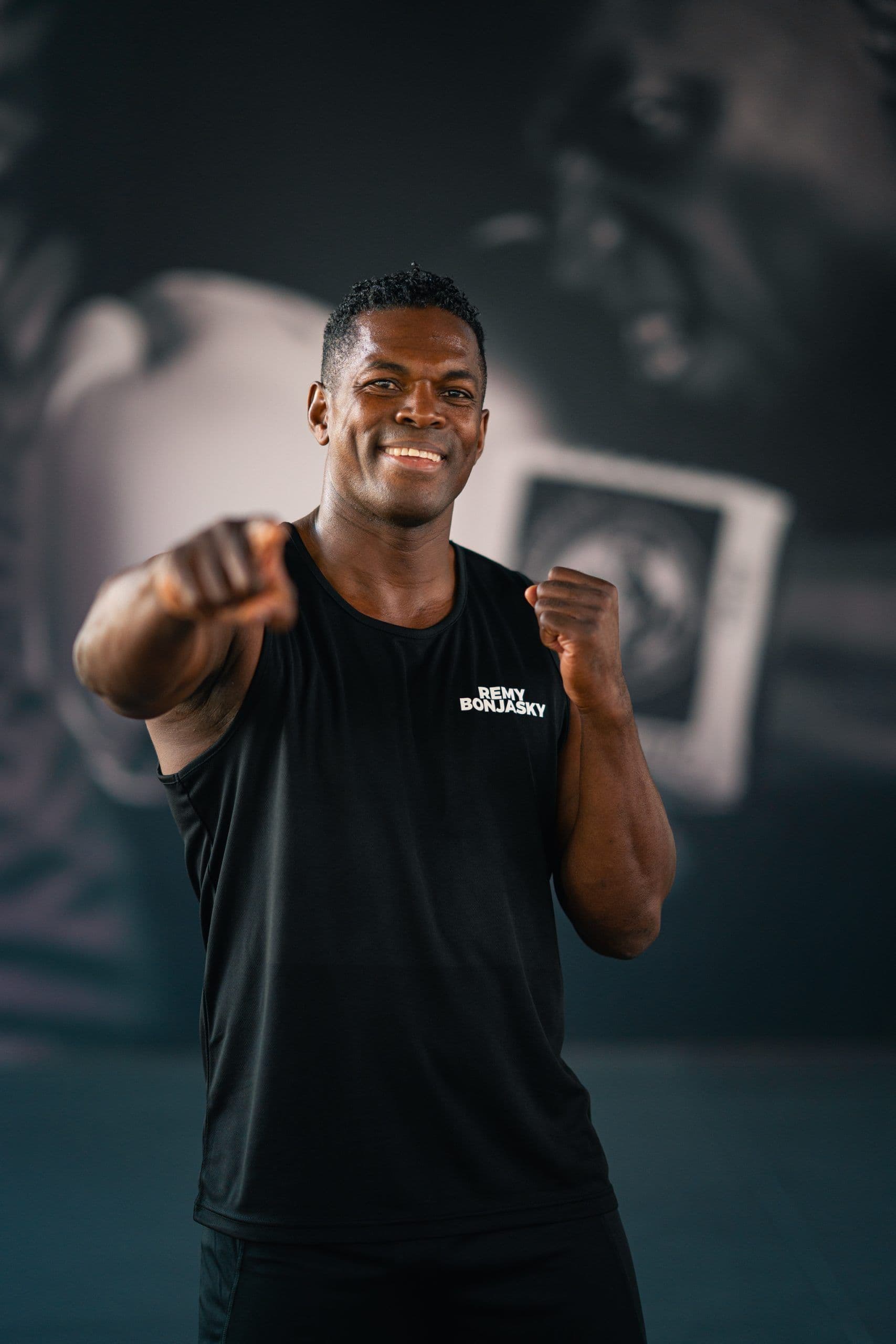
Source: Hardeman et al., 2019, International Journal of Behavioral Nutrition and Physical Activity→“I won't promise you anything I can't back up. No miracle cure, no "clinically proven". Just honest science, and an app built on it.”
Remy Bonjasky, Remy Bonjasky